

Finding Lost Voices: If Geography Has to Be Considered, Laura Riding Jackson 1901-1991
A weekly email that brings back the voices of those who have been forgotten or misremembered

Laura Riding Jackson’s life seems like a distorted legend; a story that reflects back up from the waters, blurred by capillary waves. Her writing, too, isn’t easy. It shimmers beneath the surface like a delicious fish. It seems apt to write about such a poet during the week of Gertrude Stein’s birthday (Feb. 3), as Jackson’s work has often been compared to Stein’s. For example, Nancy Carol Joyner and Allison Hersh observed in the Reference Guide to American Literature, “For Riding, as for Stein, poetic meaning can not only be found in words of the poem; it is also produced in the spaces between words, in the sparks that result from the collision of words and in the static created by the repetition of language.” It’s those sparks from the collisions of words that have long drawn me to her work.
I first discovered Riding’s work in the early 1990s when I was living in New York City, attending graduate school, and looking for female writers who challenged poetic form (like Stein, whose work I’d fallen in love with during my undergraduate years) as I wasn’t being taught many female poets, especially those who disregarded the rules.
So when I went to visit my friend J.J. in Vero Beach, FL, and she told me that Riding’s house was nearby, I couldn’t wait to see it.
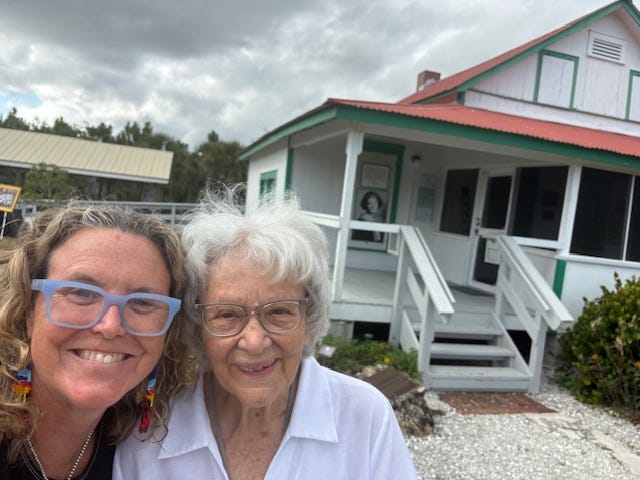
Riding’s house, like her writing, is difficult to pin down to an exact geography as it has been relocated twice since her death in 1991. When I visited it in January, the house stood on the Indian River State College Mueller Campus, adjacent to the new library, where it has been renovated and preserved by the Laura Riding Jackson Foundation.
The day we visited, the house was locked, but I could still peer into the wide screened porch and through the kitchen windows. and get a sense of the house and what it must have been like when Riding lived in it. As a poet, I think metaphorically. So the house felt like a vehicle through which I could better understand the tenor, its inhabitant, Riding.
The outside of the pine house was white, trimmed in green, and the inside walls were stained dark brown. Originally, it was located in Wabasso, Florida, on an eleven-acre citrus grove where it was built in 1907, but she and her husband did not move into it and take over managing the citrus grove until 1943. My friend J.J .told me the house is an example of Florida “cracker” architecture, characterized by raised floors, a tin roof, porches, and large windows for cross-ventilation to combat Florida’s oppressive summer heat.
When Riding’s husband, Schuyler Jackson, died in 1968, she lived on in the house alone, without electricity, until her death in 1991. She told her biographer, Elizabeth Friedmann, that she didn’t want electricity because she didn’t want the lines to mar the house’s appearance. Instead, the house was filled with kerosene lamps, and every surface was covered with papers.
Riding was never one to follow the rules set by society, either in her home, her love life, or in her work as a writer, and it’s perhaps because of this that few remember her important work as a poet, writer, and critic. In fact, after she died, many defaced her name. Sir Stephen Spender told the London Standard, “She was a witch!” Jill Neville told Independent Magazine, “I detest this woman.” However, others assumed that her name would be among the most important poets remembered from her era. “When the final verdict on twentieth-century poetry is given, she will have a very high place,” wrote Time magazine at the time of her death.
Sitting in the back garden of her home, watching the afternoon breeze rise up in the palms, I couldn’t help but wonder where the attention to her work had gone and why it had folded outside of what was being read.


Riding was born in New York City. Her father, Nathaniel Saul Reichenthal, had come to America from Austria-Hungary in 1884 during the second major wave of European emigration. When he arrived in New York, he worked in the sweatshops of the garment district. His first wife died, and soon after, he married Riding’s mother, Sarah “Sadie” Edersheim.
Riding attended Cornell University, where she met historian Louis R. Gottschalk, then a graduate assistant. They married in 1920. She began writing poetry soon after and saw her first poems published in The Fugitive, a literary magazine housed at Vanderbilt University and edited by Allen Tate, John Crowe Ransom, Merrill Moore, Donald Davidson, William Ridley Wills, and Robert Penn Warren. Tate was especially enamored with Riding’s work and encouraged the editorial staff to award her the Nashville Prize in 1924. As her literary success grew, however, her marriage began to unravel, and she divorced in 1925.
At this time, Riding’s poetry was unusual. In 1924, poets like Edna St. Vincent Millay were famous, voices quite different from Riding’s. As the poet, translator, and editor, Sonia Raiziss, reflected, "When The Fugitive (1922–1925) flashed down the new sky of American poetry, it left a brilliant scatter of names: Ransom, Tate, Warren, Riding, Crane.... Among them, the inner circle and those tangent to it as contributors, there was no one quite like Laura Riding."
The Spring Has Many Silences
The spring has many sounds:
Roller skates grind the pavement to noisy dust.
Birds chop the still air into small melodies.
The wind forgets to be the weather for a time
And whispers old advice for summer.
The sea stretches itself
And gently creaks and cracks its bones….

The spring has many silences:
Buds are mysteriously unbound
With a discreet significance,
And buds say nothing.
There are things that even the wind will not betray.
Earth puts her finger to her lips
And muffles there her quiet, quick activity….
Do not wonder at me
That I am hushed
This April night beside you.
The spring has many silences.
“The Spring Has Many Silences” first appeared in the Lyric V, no. 4 (April, 1925).
Robert Graves (who had also published in The Fugitive) read Riding’s work and was so impressed that he immediately extended an invitation to her to visit him in Europe. In 1926, she travelled to England to begin working with him on the influential book, A Survey of Modern Poetry (1927). Riding’s first book of poems, The Close Chaplet, was published by Hogarth Press, run by Virginia and Leonard Woolf. But despite her literary success, Riding’s life nearly ended by suicide on April 27, 1929, when she jumped from a fourth-story window of her London home, where she was living with Graves and his wife, Nancy Nicholson. Thankfully, Riding survived, and she went on to publish more than twenty volumes of poetry, essays, and fiction over the next ten years. She’d also establish the magazine, Epilogue, and begin Seizin Press, which would publish innovative authors like Gertrude Stein.
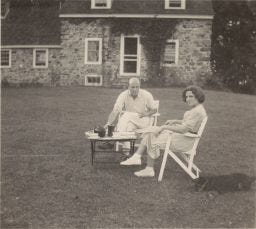
After her suicide attempt, Riding and Graves left his wife and settled in Majorca, where their home soon became a meeting place for writers. When the Spanish Civil War broke out, they were forced to evacuate. They returned to London briefly before sailing to the U.S. on the invitation of T.S. Matthews, who was the managing editor of Time magazine. Meanwhile, Schuyler Jackson, the book editor at Time, read and reviewed her work. In 1939, Riding and Graves stayed with Jackson in Pennsylvania, and when Riding and Jackson met, they instantly felt a spark. So, Riding soon left Graves for her new love interest.
And it’s with Jackson that Riding ended up buying this home in Wabasso, Florida. In the little tin-roofed shack, she forsake poetry and instead became interested in its root — in the meaning and residue of words. Standing in front of the kitchen, where I could peer into the inner rooms of the house, I could still feel the residue of that energy.
Upcoming Events and Opportunities
3/3/2026 7:00 PM CARLA KAPLAN & IRIS JAMAHL DUNKLE Copperfield’s Santa Rosa at Montgomery Village, 2316 Montgomery Drive, Santa Rosa, CA 95405
Riding like the Wind: The Life of Sanora Babb is now available in paperback!
Contribute your work to the Sitting Room Library Anthology 2026, Painter Hilma af Klint, fiction writer Lucia Berlin, park ranger Betty Reid Soskin, librarian Belle da Costa Greene, activist and author Zitkála-Šá. These are all women who shaped the world, yet only recently have they been recognized for their achievements. These remarkable women—and many others—still are not widely known beyond specific circles.
Let’s shine a spotlight on women who have been left too long in the shadows. In the 2026 Sitting Room Library Anthology we invite you to celebrate an overlooked heroine. Women who, through literature, art, or advocacy paved the way for all of us. All contributions are welcome including poetry, prose, and visual arts* that can introduce our community of readers to inspiring figures.
Contributions should be no more than two pages, 12 point font, Times New Roman. No headers or footers. Please send your work to sittingroomlibrary@gmail.com by April 15, 2026 with the subject line: “2026 Sitting Room Anthology Contribution.” Contributions may also be sent to the Sitting Room Library at P.O. Box 838, Penngrove, CA 94951.
So glad for all your great work for women’s Poetry! I am proud to be your subscriber and to read all of these wonderful accounts that you do 🩷💐
How interesting to learn she attended Cornell University. Ithaca was such an interesting place then. As interesting as Gottschalk.