


In my early twenties, I worked at a state hospital called Goldwater on Roosevelt Island in New York City. My job was to teach creative writing to residents who couldn't leave. To be honest, I was scared the first time I walked into that institution and met my students. Some of them were bed-bound; one of them, Letecia, was paralyzed, and I had to learn how to communicate with her using a letterboard. Thankfully, she was very patient as I slowly learned to watch her eyes move to groups of letters and blink until I could figure out which letter she meant. In this way, I learned that Letecia had a sense of humor, lived off ice cream (through her feeding tube), and wrote amazing poetry. Each week I sat down with my students and learned that even though I was hired to teach them poetry, I was the one who walked away with something much deeper and more meaningful than anything I could convey to them about writing. The gift I walked away from that hospital with was the story of their beautiful, individual, and important lives, which still lives on in me.
Perhaps because of this background, Doireann Ní Ghríofa’s new book, Said the Dead, spoke to me so deeply. Like Ní Ghríofa’s stunning last book, A Ghost in the Throat, we enter the narrative through the writer’s own experience of finding the story and its characters in the city archive, but the story of Said the Dead is told through the experiences of Dr. Lucia, a psychiatrist hired to work at the asylum as her first job. Like me, Lucia was young when she walked into the institution, but through her casebooks we get to know the otherwise faceless residents who lived there over her decade-long tenure.
In this way, Ní Ghríofa’s book becomes a conjuring – whereby she brings the voices of these women back to life.
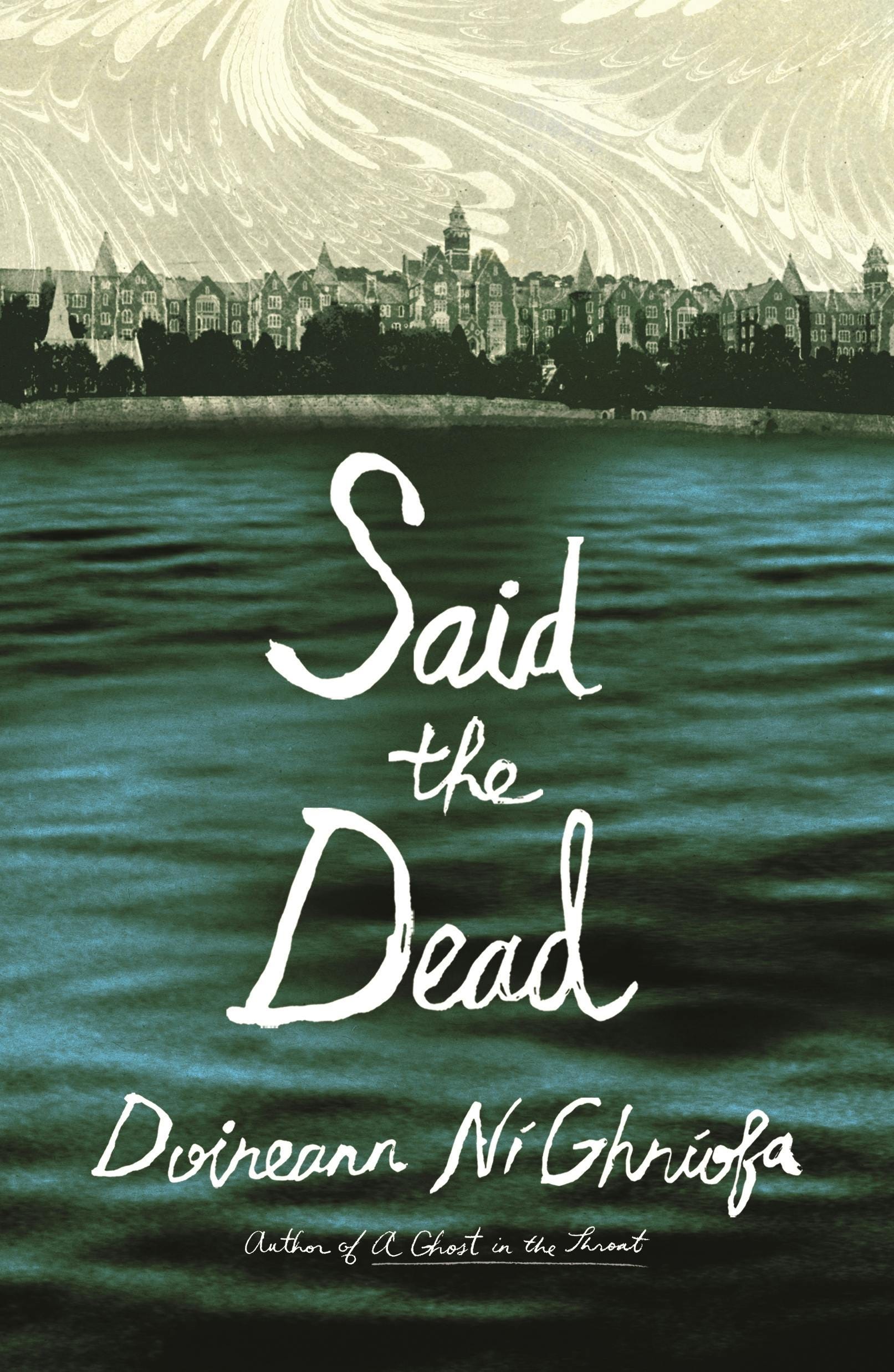
Last week, I had the opportunity to sit down with Ní Ghríofa to talk about her new book (out this week!) What follows is our conversation.
Doireann Ní Ghríofa is an Irish writer devoted to exploring how the past makes itself felt within the present. A Ghost in the Throat finds an 18th century poet haunting a young mother, leading her through visions of blood, milk, lust, and murder. Written on the roof of a multi-story car park in Ireland, it was described as “powerful” (New York Times), “captivatingly original” (The Observer), and a “masterpiece” (Sunday Business Post). A Ghost in the Throat won the James Tait Black Prize and was voted overall Book of the Year at the Irish Book Awards, while the US edition was a finalist for the National Book Critics Circle Award and a New York Times Notable Book of the Year. It was translated into 20 further languages worldwide. Both history and ghost story, Said the Dead distills hundreds of hours of archival research into a polyphonic portrayal of a 19th-century asylum. A deeply haunted book, it has been praised as ‘wildly imaginative’ (The Guardian) and ‘electrifying’ (Times Literary Supplement).
Interview
Iris Jamahl Dunkle
I’m a huge fan of your previous book, A Ghost in the Throat, because of the way that you’re pushing against the way we tell history so that it’s inclusive of female voices that have been forgotten. And I felt you really leaning into that same practice in Said the Dead, so can you talk a little bit about how this project discovered you, because that’s what it feels like it did, and how you knew to follow it.
Doireann Ní Ghríofa
Oh, what a great question. And I do feel that our projects find their way to us. I’m not sure that we choose our subjects. I do feel that there’s a certain element of choice involved in how we are drawn to them, and how they draw us towards them. It’s mysterious, you know? And when I think about it, I just end up tying myself in knots.
But yes, as soon as I heard that our city archive held the casebooks from our old city asylum, I knew I wanted to visit them. I didn’t know what to expect. I didn’t know what I would find there. I certainly didn’t realize that I was about to devote years and years of my life to the women whose lives were documented in these casebooks, and to the process of very slowly piecing together their precious lives, and trying to understand them, and trying to step a little closer to them. And I think that that was an urge that began in some way for me, with A Ghost in the Throat, in which I was seeking the ripples of the echo of a voice of another woman, an Irish-language poet who had been alive in the 1700s here near where I live, in the south of Ireland, in Cork. And I began to develop certain techniques for finding my way toward the past. Throughout the process of writing that book, A Ghost in the Throat.
And then in Said the Dead, I was drawn even further into that amazing process of developing a curiosity about someone whose life was lived many years, sometimes many centuries, before, and following that urge to see where it would lead. And that has become one of the most profound privileges of my life. I spent years studying these women’s lives in the casebooks in our city archive, and every moment I was there was a moment well spent of my brief life here on Earth. I learned so much from these women, and it was a privilege to learn from them, and in a way, to bear witness to their lives.
Iris Jamahl Dunkle
The way you let them step forward and speak is almost like you’re channeling them, you know? It’s beautiful. Did you just happen upon the story of Dr. Lucia, or was that something you knew you would find, because she’s such an extraordinary character.
Doireann Ní Ghríofa
She is an extraordinary character, you’re absolutely correct. And I was astounded when I realized that one of the doctors who was initialing each entry in these asylum casebooks was a woman, and that this was a young woman who had approached this hospital in the 1890s as her first job having qualified in medical school. I just couldn’t believe that here was an Irish woman in her 20s walking into her first job, and she was a doctor in this vast institution…I realized I wanted to follow her, and as the years unfolded, following her life from year to year introduced me to many of the women she met along the way. It’s fascinating to follow anyone through their working life, but especially someone so devoted to their patients who was practicing an early form of psychiatry. She was an attentive doctor, and she was also a good writer. When she was writing her entries in the casebooks, they were illuminating, and she included details that really spoke to me, and they really helped me to feel the presence of the woman that she was sitting in a room with on the other side of the casebook that I was reading, right? The casebook started to feel almost like an object that was helping me time travel. I was holding this crumbling casebook in my hands, and on the other side of this ripple in time, a young doctor was holding the exact same object, looking up from the page, and taking detailed notes on the woman that she was looking at. And sometimes Dr. Lucia would transcribe some of that person’s speech, and those were the moments when these people really came to life for me, because something of our essential humanity, I believe, is revealed in something as simple as our speech, in the turn of speech that we have. There’s something there. And I was so grateful every time Dr. Lucia wrote down someone’s speech, because in some way, that allowed the doctor who was standing between the patient and me on the other side of the page, almost to fade away, and suddenly, it was as though I was listening directly to the voice of this woman, who had been lost to the past, and many of them didn’t have any descendants, so I felt very fortunate to be able to hear, even for a fraction of a second, and I say hear, but in fact read their voices. And sometimes their voices would become almost like an earworm, like a pop song for me, where they would repeat themselves in my ear as I was going about my day. They really came to life for me in my living body. They became an important, rich part of my days, and a deepening, enriching force in my life. And it’s extraordinary to walk around our city, walk around the same streets, and to be able to see certain houses and know the women who were there at the turn of the 20th century, and to wrap my knuckles against the doors, and just set a little echo trembling inside the rooms that they would once have known. It’s just extraordinary to be a part, a living part, now, in our times, of the same city that they would have known so well.
Iris Jamahl Dunkle
Isn’t that the strangest thing when you do archival work: to see the ghosts of the past kind of laid over everything in a scrim, so you see both times at the same time?
Doireann Ní Ghríofa
I find that extraordinary.
Iris Jamahl Dunkle
Can you talk a little bit about what you discovered, historically, about what it was like to be a woman during the era you were covering, especially if you were poor?
Doireann Ní Ghríofa
It’s really important to emphasize that element, because these were difficult times to be a woman in Ireland. From the 1890s to the 1920s, a lot of the women who were entering this asylum in this period were extremely impoverished in ways that we wouldn’t recognize in contemporary Ireland. They were women who were often documented in the casebooks as arriving in an emaciated condition. They were so hungry. They had often, by their early 30s, given birth to 9 or 10 children. They would have lived through stillbirths, and the agonies and the grief that come with that, and they were struggling to feed their children while they themselves were extremely hungry, too. The pressures that trying to survive in the Ireland of that time exerted on the human body and the human mind are really difficult for us to fathom, I think. And what’s very clear from particularly Dr. Lucia’s notes is her sense of recognition of that there is a form at the beginning of each new patient’s pages within the casebook where the doctor is expected to fill a form with entries like cause, you know, predisposing cause, existing cause, what is it that has provoked this woman to this level of distress that society feels that she needs to be brought to this institution and oftentimes Dr. Lucia would write [that the cause was their] impoverishment, which was a fact, but also felt to me quite radical for a doctor of her time, because she was recognizing, unlike some of the other doctors who were there, that this was not necessarily any particular flaw in this woman’s choices or in her life that had led her here. This was a greater societal issue, and also the pressure of trying to function within her family under those really difficult circumstances.
Sometimes under cause, also were things like menstrual derangement, or a fall, like a head injury, which we would recognize. So, there’s a sense of being jolted when you see that kind of archaic language. And you really have to wonder at it. And yet, there is a certain amount of recognition as a woman, as I am, to read those casebooks, and to recognize that there are some things that don’t change in the life of a woman. For example, there are quite sensitive moments in a woman’s life where she can be prone to mental distress like menopause, or in the weeks after the birth of a baby. We’re very familiar with this even now, and this was not alien to these women either, or to their doctors. It was very clear to them that there were certain moments that were really, really difficult for women. And particularly if someone had been barely holding things together under very difficult circumstances when they meet those moments where their body is changing suddenly and their hormones are changing, it can become very difficult to hold on, and that is the point where we see women approaching the institution, sometimes of their own volition, sometimes brought in by their spouses, sometimes brought in by policemen, sometimes by their mothers, and we know this because these people who come with them often give a statement to the doctors as well, and that can be very illuminating to read the…report, if we could call it that, of the person who is keeping them company as they enter the institution.
Iris Jamahl Dunkle
I found it so touching how there were spots in the narrative where you would imagine a brighter ending one of the women like Dora. Can you talk about how you didn’t do that for all of them? I wondered how you made that decision, and what that felt like. Was it cathartic at all?
Doireann Ní Ghríofa
I cared so deeply about each of the women whose lives.
When I was reading each individual woman’s notes, I would turn the page and find the doctor writing in this very distinctive, elaborate copperplate handwriting that they wrote when someone was returning to their own lives, discharged, recovered. That was so moving to see that, and to bear witness to someone feeling ready to return to their own lives. It was so moving, and yet there were so many… There were so many women, and this is just the awful fact of it. There were so many women who died in that institution. Some of them arrived pregnant and died in childbirth. Some of them died of tuberculosis. There were a lot of contagious diseases, as they’re always there in institutions like that, and that was extremely saddening to bear witness to someone’s so slow decline and death. And I really did struggle with that. And yet, it felt important in the act of writing to be true to that, to be true to how difficult their life was, how hard things were when they entered this institution, how sometimes it was almost impossible for some people to survive those conditions, and to make their way home and back to their own lives. And it was important to tell the truth of that. No matter how I wanted to write a happy ending for every single one of those women, it wouldn’t have been right. Many of them lived lives of suffering, and I felt that it was important to honor that with a righteous outrage of an Irish woman a century later who has also struggled with her own mental health.
There were several cases, however, that I found…just heartbreaking. There was one teenager named Dora, who came from a really difficult home circumstance. There was a very small Jewish population in Cork City at the time, and Dora was from a Jewish family. She had been well-educated, and it was documented in her notes that she was a great novel reader, and she really seemed to have grown a lot of the joy of her life from reading, and the act of reading. But her family were extremely poor, and so the decision was made that she would go to work, and she worked as a seamstress. She was worked extremely hard, and when her rabbi visited her in the institution, he commented on that. Her parents hadn’t understood how vulnerable she was, and that they severely regretted how hard she’d been worked. Dora entered the asylum really, really wanting to die, and she articulated that over and over again, and she wouldn’t eat. And they couldn’t save her. She didn’t want to be saved. She wanted to die. And she did die, and her cause of death was recorded as exhaustion from acute melancholia. And she was 16 years old. And that really… still, now I have goosebumps talking about Dora. And yet, I am so glad that you and I both know her name, and that we are speaking about her life right now, and that she has become so precious to me when I came… to writing about her life. I invited the reader of Said the Dead to imagine a different ending to her life with me alongside me. So, I describe the actuality of her life and death in all its horror, and then I invite the reader to imagine a different turn of events, where her family aren’t as impoverished as they sadly were, and Dora is afforded the very ordinary luxury of so many teenagers, of just idly picking up a book and walking into her back garden to sit under a tree and read. And that’s all I could give her from so far in the future, to be remembered and to be written into a book. When she had gotten such joy herself from the act of reading, she is now in some small way, alive in this book, and cherished. Very much cherished by me, and I hope by the readers of Said the Dead.
Iris Jamahl Dunkle
Yeah, I think that was beautiful.
You describe in the book this idea of what the archives were like: vellum scrolls and vaults where ancient secrets might be stored. Yeah, it’s a romantic idea, right? But the reality is, it’s this controlled area where you get limited times with these objects that are holding the secrets to people’s lives who have been forgotten. And I think Derrida’s idea of archival violence happens most often to women. Especially the women that you’re covering in Said the Dead. So the idea that you are finding them, and bringing them back feels like a powerful act of defiance. They could have completely disappeared, and instead, you came to meet them where they were. And I want to talk to you a little bit about your scholarly approach. You had a similar method in your previous book, A Ghost in the Throat, you had to do some invention, you had to write yourself into it as well as a way to enter the story. You had to take a non-traditional approach to give these women their voices. Can you talk about what that means to you as a practice, as a writer?
Doireann Ní Ghríofa
I think the reader’s notion is very illuminating, particularly in terms of Said the Dead. I was entering the archive as the person who didn’t know what they were doing. Just an ordinary person, not a historian, not a professional researcher, and it’s in that role that I invite the reader of Said the Dead to join me, sitting in the archive, being handed one of the casebooks from this old asylum, and opening it, and beginning to read, because all archives are bound by rules, and the rules are there for a reason. The rules are there to shield the artifacts that are being protected. That’s why they’re there. And they’re shielding them from people like me, who are so enamored with the research that they’re doing and so driven that they really just want everything, and it is the archive and the archivist’s role to protect these artifacts. And in our city archive, they’re extremely devoted to the collections in their care, and they’re extremely good at doing their job, which means that researchers like me will often feel the temptation to transgress, or to break the rules….In a situation where there are a lot of rules, I am always quite tempted to brush against that authority, and I tried to welcome the readers with me to the experience of encountering the casebooks, of the act of reading the casebooks, but also that occasional impatience with the fact that there are rules, and they’re important, and the feelings of impatience that sometimes come with rules. I suppose that’s what it is. But at the end of the day, I have enough distance now from those years and years of research that I can say I’m so grateful for our City Archive and how seriously they take the care of all the artifacts, not just these casebooks, of all the artifacts that are held there. It isn’t the case for every similar institution around Ireland, of which there are many, where the casebooks and the written records were kept and shielded in such a way by their local archives. In fact, I would say the situation in our city is relatively rare. I know I come across as a little impatient sometimes with all the rules, but at the end of the day, they’re there to protect the books, you know?
Iris Jamahl Dunkle
Oh, yeah. No, I think it’s the job of the writer to push against the rules,… I do it myself. I thought it was fascinating how by telling the stories of these women, you were also able to tell the story of the history of this very complicated time in Ireland. Especially the, you know, when we came across the story of Muriel. Can you talk a little bit about that?
Doireann Ní Ghríofa
What led me through the book in some ways, was following the working life of Dr. Lucia Strangman, later Fitzgerald. Through her working years, and for many of those years. From her first days in the institution, when she moved into her own little apartment among the wards, and she lived there for years and years, and she fell in love with one of the other doctors, and was married there, and they had a shared apartment there in the hospital itself, and she gave birth to her children there, and looked after her patients there every day, and she was very much part of the life of this long, strange building.
She was an extraordinary person to follow through her working life, because at a certain point, she and her young family moved out of their apartment in the hospital and moved to a house that was slightly up the hill. It was still within the grounds of the institution. Where it had been, quite run down, and they had a renovation project, and then she and her husband John and their children moved into this house, which was called Mile House. And she and her husband started what they called an outpatient clinic, but what seemed to me was a radical departure and quite an experimental approach and really astounding in the scale of their shared ambition because what they wanted to do was… and this is how Dr. John phrased it, they wanted to eradicate insanity.
Now, that is extraordinary for people of their profession. That’s what they were setting out to do, and they were determined, and their plan was, if they could only meet people at an earlier point in the distress that might later on have sent them into the asylum as their patients, and they may have met them there. If they could only meet them earlier in their path and they could give them intense treatment at that point, that these people might never end up needing care, or that their families might not end up seeking care for them within the institution.
And that was what they set out to do. And their techniques were really revolutionary at the time in Ireland. I mean, they moved there in 1913, and the techniques they were using were mesmerism, and techniques of hypnosis, and what we would recognize as a very primitive form of talk therapy. So, it was important to both that this clinic would be freely sought and free of charge. So, it was open to everyone, the entire city, anyone who was worried about a family member, worried about a friend, anyone who felt that their own mental health needed care could approach this house and would be taken in as a patient, and wouldn’t be charged at all. That was so important to them. And what would happen in that situation was that they would be welcomed into their front room, and the room would be made dim, and they would be invited to lie on the couch and to speak of what was on their minds. Now, culturally, that is very familiar to you and to I, okay? But boy, at that point in Irish history, I can only imagine how strange that must have felt, and how experimental. And they were really, really successful in this clinic. I was fortunate to find an article, written by John, Dr. Lucia’s husband detailing the steps in their process, and several case studies of what they saw as their successes, and that was illuminating, and it was a pleasure to write about.
To answer your question, during the years that they were running this clinic at Mile House, one of the people who moved in, and this was rare, this was rarer that they would have an inpatient within their own home was Muriel McSweeney. She was an extraordinary figure who was wildly radical. She was married to a revolutionary soldier who, at that point in the history of our city, was waging war against the English with guerrilla warfare, and he was the mayor of the city. She had suffered from depression on and off all her life, and continued to after her time at Mile House, and sought help through several institutions throughout Europe, which is documented really beautifully in a book by her daughter, Maire MacSwiney Brugha, and the name of that book is History’s Daughter. I really recommend it; it’s a fantastic book. And she writes beautifully about her mother, Muriel, who is a very complex character. I was very surprised to find letters that refer to her time in Mile House and her treatment there by Dr. Lucia. And it was extraordinary to imagine the intersection of these radical medics and their intention to help people and to eradicate all insanity. That was their aim. To imagine the intersection of that approach and such a key moment of our revolutionary history here in Ireland. It was extraordinary.
Iris Jamahl Dunkle
We see it from a different perspective that way, by seeing it through Muriel’s experience.
Doireann Ní Ghríofa
Yeah, very much so. And it was interesting to make myself a student of Muriel’s life through the archives that I had access to, and I learned so much throughout the process of writing this book, not only about accessing our city archives and the asylum records that are held there.But all are many other archives. I became a real nerd for the census.
Iris Jamahl Dunkle
Right, I understand!
Doireann Ní Ghríofa
All the records of birth, deaths and marriages, I became good at navigating those records. I learned from my mistakes, many mistakes. It took a long time, but I got there eventually. And, old newspapers. Using all those sources to piece together a sense of the texture of Muriel’s life, and as I say, her daughter’s book, History’s Daughter, was really special to me in that process, and really, it’s a volume that’s very dear to me. It was fascinating to come to know Muriel through making a story of her life, and I am in awe of her. What a fierce person she was, and what she achieved in her life. She’s amazing.
Iris Jamahl Dunkle
I loved how you described her suitcase.
Doireann Ní Ghríofa
Sometimes if I found it difficult to begin to write about someone, I would find an object, and start with the object as an exercise for myself. And once I could find the object and really dream my way closer to that object, then I could imagine that object in the hand of another person. And that was always very, very helpful to me.
Iris Jamahl Dunkle
Yeah, no, that makes sense. That’s a trick of biography: the idea that the sensory experience of an object can help you enter somebody’s life, you know?
I feel very drawn to the cause of bringing up the stories of people who have been forgotten or misremembered, and I feel very much a sisterhood with you in that aspect. And I’m wondering if that’s something that you, I mean, you’re… you’re a young writer, and you have many years ahead of you, but do you see yourself drawn to projects like this in the future?
Doireann Ní Ghríofa
Yeah, what I suspect is that there are certain people like you and like me, the ones who are bitten by the bug of this kind of research, of really studying someone else’s life and allowing them into our lives deeply, that it changes us in some profound way. That sense of reaching out to someone in the past and waiting, and waiting, and learning more and more about them, and keeping your hand open, and reaching out until suddenly you feel a hand enter your hand. That really is how the process of writing my books feels to me. And there’s a real intimacy in that. And I have felt so fortunate to be drawn to write the books that have come to me so far…and I feel that I’m just hitting my strides, you know? This book has taught me so much about finding clues and I’d like to keep going if I’m lucky enough to be given some more years on this earth. I would like to keep going. I would like to see what happens next, and who I am given to write about next. I’m curious about that. I don’t know yet. I’m just so hopeful, as a writer, on the page, and when I’m looking towards the arc of my writing life, hope is the main emotion that I feel; I hope to become stronger as a writer. I judge my strength as a writer by how closely I can address my readers, by how close they can feel me through the page, and feel the person that I’m writing about, the story that I’m writing about, the times that I’m writing about. And it’s important to me to become stronger in that respect because the readers mean so much to me. I mean, what astounds me is to imagine years from now that one of my books, just one of my books, might have survived and is, like, on a shelf somewhere, and someone is walking along and just decides to pick it up for who knows what reason. But that I will be alive in some way in that moment, and that the people I have devoted my life to writing about would also be alive somehow in that moment, brought to life again in someone else’s human imagination. That’s extraordinary, so extraordinary to me, and… and I hope that I can keep writing, and I hope that that will happen someday.
Iris Jamahl Dunkle
It feels like a very important impulse these days, as the archival wall shuts down when people are less inclined to look beyond what’s on the internet to find the true stories out there. So I feel like that imagined future you have is so important, and also that it might inspire someone in the future to go into an archive and find more of these stories that have been forgotten.
Doireann Ní Ghríofa
Oh, yes, I love that. Yeah, absolutely.
Upcoming Events
September 29 5:30 - 7:30 PM, The Hours Before Dawn Book Club led by Iris Jamahl Dunkle
The Sitting Room Library and Lost Ladies Book Club - Let’s gather to discuss The Hours Before Dawn by Celia Fremlin. This September, The Lost Ladies of Lit Podcast aired an episode about Celia Fremlin’s The Hours Before Dawn, the Edgar Award-winning psychological mystery about a young mother teetering on the brink of exhaustion (and perhaps sanity). Sign up on Eventbrite
October 1, 6:00 PM - Iris Jamahl Dunkle reads for Marin Poetry Center at Mill Valley Library
Creekside Room, 375 Throckmorton Ave, Mill Valley, CA 94941. For more information.
October 8, 5:30 - 7:30 PM (online) The Pilgrimage Reading Group
Join us for a monthly online reading group for Dorothy Richardson’s series novel, Pilgrimage. (To read my earlier post about Richardson on Finding Lost Voices) Dorothy Richardson’s series novel Pilgrimage runs to over 2,000 pages and 13 “chapter-volumes” and contains some of the most challenging English prose this side of Finnegans Wake. It’s also arguably the most neglected major work of 20th-century English fiction. Despite its recognition as a major work, most bookshops in the U.K. don't stock it, and it's available only as print-on-demand. And in the United States, it’s been out of print for over 40 years (until now). We’ll be using the new edition, available for sale exclusively from Asterism Books. Upon joining, participants will receive a 25 percent discount on the books. To sign up, email sitting.room.library@gmail.com
Thank you for this. My great grandmother died in the Killarney Asylum. I am writing about her.
fantastic interview!!! you go Iris, deep and sensitive